Web Log
Data for Medical Documentation is Critical to Solving the Healthcare Crisis
8/10/2026 6:46 PM
Data for Medical Documentation is Critical to Solving the Healthcare Crisis
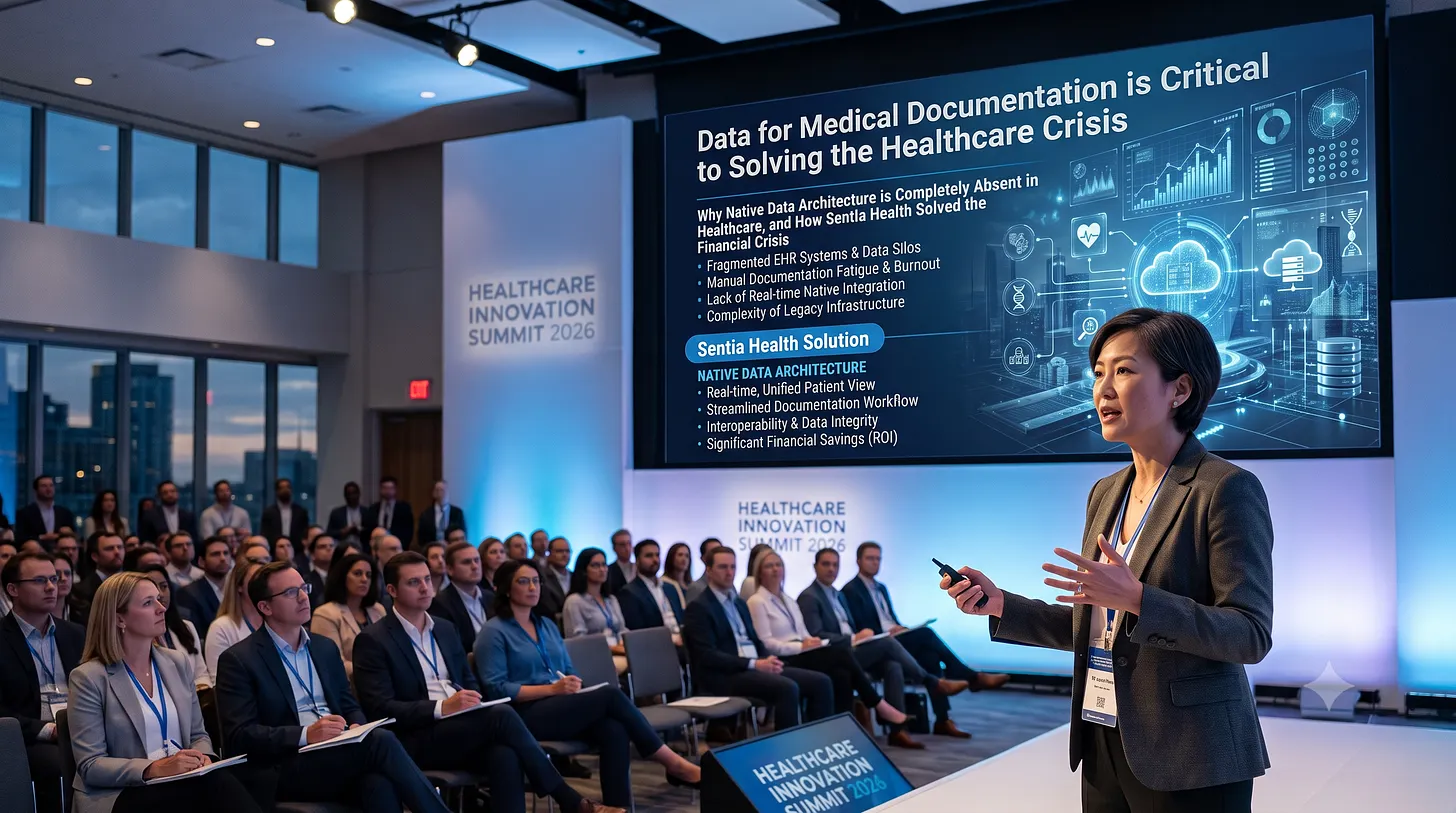
Why Native Data Architecture is Completely Absent in Healthcare, and How Sentia Health Solved This and Thus, Solved the Financial Crisis
Introduction
Documenting clinical encounters using natural language introduces structural noise that computers cannot process. This architectural flaw drives the complexity, latency, and cost of modern health systems. Transitioning to native computational data enables automated processing, creating a simpler, faster, and more cost-effective framework. Data allows automation of this processing and thus is simpler, faster and cheaper.
Medicine operates on ambiguous human language (free text, unstructured narrative notes, and clumsy drop-down menus) disguised as digital electronic medical records (EMRs). True transformation requires shifting to pure, discrete data structures. Converting clinical observations into prose forces computers to act as passive paper-substitutes rather than processing systems. Transitioning to native computational data decouples healthcare from typing, reduces administrative burden, and enables true, real-time automation across medical practices and insurance adjudication.
The Situation
- Narrative Dependency: Modern Electronic Health Records (EHRs) are fundamentally digital word processors where clinicians spend hours typing free-text clinical notes, progress reports, and subjective discharge summaries.
- The Drop-Down Fallacy: In an effort to capture structured inputs, current EMR systems resort to thousands of nested drop-down menus. This creates a fractured user experience that frustrates clinicians without creating truly operable structured data.
- Unstructured Bloat: Key clinical information—diagnoses, history, lab interpretations, and treatment plans—is trapped inside blob text, PDF scans, or legacy HL7/FHIR wrappers that simply transmit narrative text over APIs.
- Burnout and Inefficiency: Physicians spend nearly two hours on administrative documentation and EHR navigation for every hour of direct patient contact, driven primarily by text generation and billing verification requirements.
The Logical Outcome
- Escalating Administrative Overhead: As documentation requirements expand, healthcare administration costs will continue to surge, siphoning money away from direct patient care.
- Artificial Intelligence Bottlenecks: Generative AI tools and ambient scribes that draft text notes merely digitize the wrong paradigm faster. Parsing natural language for clinical or financial decisions remains probabilistic, error-prone, and prone to hallucination.
- Interoperability Failure: Text is inherently ambiguous. Transmitting free-text notes across healthcare systems leads to fragmented patient histories, duplicated medical testing, and preventable diagnostic errors.
- Delayed Adjudication & Waste: Insurers must employ manual human reviewers or complex NLP software to read textual notes to determine coverage, causing claims rejections, administrative friction, and massive financial waste.
The Short Answer
- Replacing Text with Discrete Data: Capture clinical observations, diagnostics, and treatments directly as deterministic, computational data points rather than narrative prose or drop-downs.
- Immediate Operational Benefits: Eliminates physician typing, simplifies data exchange, enables instant automated billing and claims adjudication, and gives clinicians real-time decision support at the point of care.
The Slightly Longer Answer
Text/Language Cannot Be Used to Document Patient Care: Natural human language is designed for communication, not precise data representation. Free text introduces subjectivity, nuance, and structural noise that computers cannot reliably process.
Here are ten advantages of discrete data over text:
- Deterministic Computer Computability
Free text requires Natural Language Processing (NLP) or LLMs to "guess" intent, which introduces probabilistic error and hallucination risks. Discrete data (coded parameters, numeric values, standardized ontologies) is deterministic—allowing computers to parse, validate, and execute logic with 100% computational certainty. - Real-Time Clinical Decision Support (CDS)
Structured data feeds instantly into automated safety algorithms at the point of care. An alert system can cross-reference a newly prescribed drug code against a patient’s coded allergy list instantly, whereas scanning through paragraph notes for buried drug interactions introduces unacceptable delay and risk. - Semantic Interoperability Across Systems
Text is inherently ambiguous—a clinician might write "shortness of breath," "SOB," "dyspnea," or "breathless." Discrete data mapped to universal terminologies (like SNOMED CT, LOINC, or RxNorm) eliminates vocabulary mismatch, ensuring system A knows exactly what system B transmitted without human interpretation. - Instant Queryability and Search
Locating specific clinical values in free text requires full-text searches across thousands of documents, often missing critical nuances. Discrete data resides in relational or graph databases with specific schema keys, enabling instant, high-precision filtering (e.g., “Find all patients over age 50 with HbA1c > 8.0 on Metformin”). - Automated Claims and Revenue Adjudication
Insurance claims processed via textual notes require expensive, slow manual coding and human prior-authorization reviews. Structuring diagnoses and interventions into discrete code sets allows rules-based billing engines to evaluate, approve, and reimburse claims automatically without administrative friction. - Population Health and Aggregate Analytics
Extracting trends across millions of patients (e.g., detecting early disease outbreaks or tracking drug efficacy) is computationally prohibitive when buried in narrative text. Discrete data allows epidemiologists to aggregate metrics across broad populations instantly. - Reduction of Clinical Burnout
When systems shift from forcing doctors to compose lengthy prose or navigate drop-downs to capturing discrete data natively, documentation overhead drops. Eliminating manual text entry restores hours spent typing back to direct patient interaction. - Automated Clinical Trial Matching
Identifying candidates for medical research using unstructured text requires manual chart audits. Discrete patient parameters (genomic markers, lab thresholds, stage-coded diagnoses) can be instantly cross-referenced against complex trial eligibility criteria. - Data Integrity and Version Control
Narrative text leads to copy-pasting old notes ("bloatware" documentation), propagating outdated or conflicting medical histories indefinitely. Discrete data entries are time-stamped, atomic units that allow systems to maintain clear audit trails, accurate updates, and precise historical state changes. - Scalable Machine Learning and Advanced AI
Machine learning models perform best when trained on clean, normalized, high-density data matrices rather than noisy, unstandardized text strings. Native discrete data dramatically accelerates model training speed, reduces dataset cleaning overhead, and increases predictive accuracy.
Here is what we should do and have done to utilize this discrete data:
- Re-Architecting the EMR from the Ground Up: Current legacy EMRs (e.g., Epic, Oracle/Cerner) are fundamentally built on outdated text documents wrapped in modern interfaces. Sentia Health advocates for replacing text entry entirely with native data capture models—built without text boxes or thousands of drop-down menus.
- Automate Real-Time Adjudication: When clinical records are captured natively as discrete data, patient encounters can be evaluated and reimbursed automatically. This eliminates the need for post-hoc coding, prior authorization back-and-forths, and expensive insurance claims processing.
- Eliminating Healthcare Waste: Sentia Health estimates that shifting to a fully data-driven EMR architecture combined with integrated coverage models could remove hundreds of billions of dollars in administrative waste overnight.
- Actionable Analytics & True AI Utility: A native data architecture allows algorithms to execute deterministic medical safety rules, track epidemiological trends, and analyze clinical outcomes instantly, without relying on complex, unreliable Natural Language Processing (NLP) models to "guess" what a doctor typed.
Conclusions
The evidence demonstrates that natural language is structurally incapable of supporting automated clinical and financial operations.
We have shown that data is a better way to document a patient encounter.
System Demonstration & Proof of Concept
What we have not done is show you a better way to input this data, so let’s correct that now. Watch this 7 minute video detailing a practitioner dictating her notes into our system and how it translates her speech directly into schema-enforced data elements suitable for automating any number of health processes and particularly the coverage portion:
This video demonstration was pulled from a working application we wrote to showcase the latest technology. To see how this fits into Sentia’s EMR and how we automate the health coverage industry completely see this video demonstration:
https://sentiahealth.substack.com/p/sentia-healths-emr-video-demonstration
This is the only application of its kind. By that, we mean this is the only data-drivenEMR on the planet. With it we can automate much of hospital and practice administration, automate hospital and practice work distribution, and as stated, automate the entirety of the health coverage industry. This automation results in a cost reduction of more than 25% at the hospital or practice level and a whopping 65% cost reduction at the patient/insured level. With the system and only with this system can we cut the average cost to US patients to about 25% less than their European brethren.
For a detailed analysis of how we use data to automate these processes read Saving Healthcare: Putting all the Pieces Together
https://sentiahealth.substack.com/p/saving-healthcare-putting-all-the
There are many benefits to a data-drivenEMR, and we simply listed a few. There is only one data-driven EMR on the market and we have shown you a demonstration of it above.
We have shown a way to revolutionize the way medical records are thought of, executed, used and searched. This eliminates Epic, all the legacy EMR vendors and makes research a simple pick and click operation, saving millions of lives.
Financial & Administrative Impact
We have shown a way to integrate health coverage into the EMR. The practice or hospital gets paid as the practitioner documents patient care. Capturing care natively as discrete data eliminates:
- Medical coding
- Verification
- Adjudication
- Pre-authorization
- Denials
- Delays
- Insurance networks
- Rate negotiations
- Sales/brokers/agents
- third-party EMR costs
- Insurance skyscrapers in every major city
- Hundreds of thousands of insurer employees
And removes all the insurance induced administrative friction, third-party margin siphoning, and claims processing overhead and reduces cost by about half.
It also eliminates Epic/Cerner AND the legacy insurers.
It also makes your facility leaner faster, more efficient and more profitable.
This system includes the automation of the health insurance industry completely, eliminating more than half the costs by Sentia as the coverage company, employer based captive or TPA or by direct payments to doctors and practices.
Here are additional points detailing the costs incurred by the legacy insurance companies that you pay currently, in addition to wasting about half your premium, according to Grand View Research and current as of 2023 and that Sentia would eliminate completely:
Medical Records:
- The average practitioner spends $35,925 annually on electronic medical records
- The average patient spends $106 annually on electronic medical records
- The average patient encounter or visit cost for electronic medical records alone is $32
Medical Coding:
- The average practitioner spends $20,286 annually on medical coding
- The average patient spends $60 annually on medical coding
- The average patient encounter or visit cost for medical coding alone is $18
Compliance and Efficacy Reporting:
- The average practitioner spends $17,165 annually on compliance and efficacy reporting
- The average patient spends $51 annually on compliance and efficacy reporting
- The average patient encounter or visit cost for compliance and efficacy reporting alone is $15
Totals:
- The average practitioner spends $73,376 annually on completely avoidable costs
- The average patient spends $217 annually on completely avoidable costs
- The average patient encounter or visit cost for completely avoidable costs alone is $66
At $66 per visit in pure administrative waste, overhead costs frequently exceed the net operating margin of the encounter itself. There must be a better way. There is a better way and Sentia has it.
Remember also that these costs are over and above the 65%+ your insurance company retained as administrative friction and payer margin .
Implementing this system should be fairly simple and will completely revolutionize the way healthcare is delivered and paid for, saving millions of US lives and billions around the world.
Summary & Contact
We have shown a way to use this system to make the best healthcare system in the world also the most efficacious and the most affordable.
If you liked what you read, contact us here, on our site, SentiaHealth.com, our parent company SentiaSystems.com, or send us an email to info@sentiasystems.com or info@sentiahealth.com.
| Date Written | Comment By | Comment |
|---|